|
var TRINITY_TTS_WP_CONFIG = {"cleanText":"CFMEU Corruption: Crime, Cover-Ups & Govt Complicity (2025). The CFMEU\u2019s Dual Crisis \u2013 Protector or Predator?\u23f8\u2587The Construction, Forestry, Maritime Employees Union (CFMEU) once stood as a fortress for Australia\u2019s blue-collar workers, its foundations built on the bedrock of fair wages, safe worksites, and collective bargaining. For decades, it wielded its influence to shield laborers from exploitation, negotiating hard hats and hazard pay with the grit of a seasoned negotiator. Today, however, the fortress shows cracks wide enough to drive a bulldozer through.\u23f8\u2587Revelations from a 60 Minutes Australia in March 2025 paint a starkly different picture: a union hijacked by organized crime, its leadership entangled in a web of kickbacks, violence, and taxpayer-funded racketeering. The CFMEU now faces a crisis of identity\u2014is it still a guardian of workers, or has it morphed into a predator feeding on the very people it vowed to protect?\u23f8\u2587The rot runs deep. Victoria\u2019s $150 billion Big Build infrastructure program, intended to modernize roads and rail, has instead become a \u201choneypot\u201d for bikie gangs and underworld figures like Mick Gatto, a man whose r\u00e9sum\u00e9 reads like a crime thriller. Subcontractors on government projects admit to paying \u201cprotection money\u201d to Gatto-linked entities, while CFMEU delegates\u2014some with rap sheets longer than construction blueprints\u2014oversee sites where intimidation is as common as hard hats.\u23f8\u2587The union\u2019s Victorian branch, once a powerhouse, now resembles a \u201ccrime gang,\u201d according to investigators. Even federal intervention in 2024, which placed the CFMEU under administration, has failed to stem the bleeding. Taxpayer dollars flow unabated into projects where bikies collect paychecks for \u201cghost shifts,\u201d and women workers face assaults met with institutional silence. This is not just a union in crisis\u2014it\u2019s a betrayal of its founding mission.\u23f8\u2587Founding Principles vs. Current Reality: A Union Unmoored\u23f8\u2587When the CFMEU was forged in the fires of Australia\u2019s labour movement, its mandate was clear: protect the worker. From the timber mills of Tasmania to the skyscrapers of Melbourne, the union fought for fair pay, safer sites, and dignity in dangerous jobs. Its early victories\u2014like the 1982 Green Ban strikes that saved historic sites from demolition\u2014cemented its reputation as a David against corporate Goliaths.\u23f8\u2587Fast-forward to 2025, and the Goliaths aren\u2019t just corporations; they\u2019re Gangland kingpins and bikie warlords. The CFMEU\u2019s Victorian branch, in particular, has become a case study in institutional decay.\u23f8\u2587Consider the Big Build, Victoria\u2019s flagship infrastructure program. Designed to create jobs, it has instead become a playground for organized crime. Outlaw motorcycle gangs (OMCGs) like the Rebels and Comancheros have embedded hundreds of members as CFMEU delegates, their tattoos hidden under high-vis vests. These \u201cdelegates\u201d rarely swing hammers; instead, they collect up to $10,000 weekly for \u201cghost shifts\u201d\u2014no-show jobs that drain taxpayer funds.\u23f8\u2587Meanwhile, figures like Mick Gatto operate as industrial \u201cfixers,\u201d extorting subcontractors for \u201cconsulting fees\u201d to avoid disputes. A 60 Minutes Australia\u00a0expos\u00e9 revealed how Gatto\u2019s accountant, Charles Pelino, funneled millions through dummy companies, with invoices tied to state-funded projects like the Metro Tunnel. The CFMEU\u2019s original mission to uplift workers now lies buried under layers of graft, its leaders either complicit or powerless to stop it.\u23f8\u2587Even the union\u2019s internal safeguards have crumbled. When whistleblower Lily Munro reported a bikie delegate smoking meth on-site, she was blacklisted\u2014not by the company, but by the CFMEU itself. \u201cIt\u2019s nothing short of putrid,\u201d Munro told investigators, her story echoing dozens of others.\u23f8\u2587The Watson Report, a 2024 inquiry led by eminent barrister Geoffrey Watson SC, likened the CFMEU\u2019s culture to \u201can episode of The Sopranos,\u201d where threats and payoffs are routine. Yet, as the Wilson Inquiry\u2014a state government probe\u2014showed, accountability remains elusive. Watson accused it of being a \u201ccover-up,\u201d designed to shield bureaucrats and ministers from scrutiny. The CFMEU\u2019s fall from grace isn\u2019t just a failure of leadership; it\u2019s a systemic collapse of the principles it was built to uphold.\u23f8\u2587Key Allegations: A Triad of Corruption, Violence, and Exploitation\u23f8\u2587https:\/\/www.youtube.com\/watch?v=mO3fdpf1FYw\u23f8\u2587The CFMEU\u2019s entanglement with organized crime isn\u2019t a mere footnote\u2014it\u2019s the headline. And at the center of it stands Mick Gatto, a man whose nickname \u201cThe Munster\u201d undersells his grip on Victoria\u2019s construction sector. Gatto operates as an industrial \u201cfixer,\u201d brokering deals between terrified subcontractors and CFMEU-aligned thugs. His dummy companies, fronted by accountant Charles Pelino, invoiced over $2 million in 2024 alone for \u201cconsulting services\u201d\u2014a euphemism for extortion.\u23f8\u2587Subcontractors on the Metro Tunnel project admitted to 60 Minutes that refusing Gatto\u2019s \u201chelp\u201d meant delays, sabotage, or worse. \u201cIt\u2019s like paying a toll to drive on a road you built,\u201d one contractor said. The Australian Federal Police\u2019s March 2025 raids on Pellegrino\u2019s offices uncovered a paper trail linking payments to Rebels bikie gang members, who act as CFMEU delegates on government sites.\u23f8\u2587This shadow economy thrives on fear. Take Joel \u201cJohnny Two Guns\u201d Walker, a Rebels enforcer with a manslaughter conviction, who was appointed as a health and safety rep on the Footscray Hospital redevelopment. Walker\u2019s job? Not enforcing safety protocols, but ensuring subcontractors \u201cdonated\u201d to Gatto\u2019s network. The Watson Report likened such appointments to \u201cletting foxes guard henhouses,\u201d noting that 30% of Victorian CFMEU delegates have criminal ties.\u23f8\u2587Meanwhile, \u201cghost shifts\u201d\u2014where bikies collect wages for no work\u2014drain $5 million annually from the Big Build budget, according to a leaked 2024 Infrastructure Victoria audit. The CFMEU\u2019s veneer of legitimacy cracks under the weight of these revelations.\u23f8\u2587Violence and Gender-Based Abuse: When \u201cSafety Reps\u201d Become Predators\u23f8\u2587The CFMEU\u2019s betrayal of workers is nowhere more visceral than in its treatment of women. In July 2024, a video leaked to The Age showed a CFMEU health and safety representative assaulting a female traffic controller during his lunch break. The victim, whose identity remains protected, was later blacklisted from state projects for \u201ccausing trouble.\u201d\u23f8\u2587Lily Munro, a single mother working on the Big Build, faced similar retribution. After reporting a bikie delegate for smoking meth on-site, she was labeled a \u201ctroublemaker\u201d and barred from jobs. \u201cThey treat us like property,\u201d Munro explains, her voice trembling. \u201cComplain, and you\u2019re gone.\u201d\u23f8\u2587These aren\u2019t isolated cases. A 2025 Victorian Ombudsman report found that 68% of women on CFMEU-controlled sites experienced harassment, with 40% fearing physical retaliation. Lisa Zanatta, the union\u2019s former women\u2019s rights officer, became part of the problem. Secret recordings revealed Zanatta dismissing complaints and even leaking victims\u2019 details to abusers\u2019 relatives. \u201cYou\u2019re never welcome back here,\u201d she told Munro after she reported the meth incident.\u23f8\u2587Domestic violence expert Jess Hill likened the CFMEU\u2019s culture to \u201ca boys\u2019 club with jackhammers,\u201d where intimidation is institutionalized. For women like Munro, the union\u2019s promise of protection rings hollow\u2014a slogan plastered over a safety net full of holes.\u23f8\u2587Financial Corruption: Taxpayer Dollars Fueling the Underworld\u23f8\u2587Follow the money, and you\u2019ll find the CFMEU\u2019s fingerprints on every dollar. The union\u2019s Victorian branch funnels kickbacks through a labyrinth of labour hire firms, many tied to bikie gangs. On the Metro Tunnel project, subcontractors paid $600,000 annually to \u201cCFMEU-approved\u201d firms\u2014a thinly veiled bribe to avoid strikes. These firms, in turn, kick back 20% to Gatto\u2019s network, per AFP financial records. The scheme mirrors tactics from the U.S. mafia\u2019s playbook, where \u201cpeace payments\u201d keep worksites quiet and wallets full.\u23f8\u2587The most egregious fraud, however, is the \u201cghost shift\u201d racket. At the West Gate Tunnel project, 15% of workers listed on payrolls were fictitious, a 2025 ABC News investigation revealed. Bikies like Comanchero affiliate Mark \u201cThe Blade\u201d Smith collected $3,000 weekly for jobs they never showed up to\u2014a scam costing taxpayers $14 million over two years. Meanwhile, CFMEU-linked companies like M Group Trades, tied to Gatto, defaulted on $7 million in taxes while winning state contracts. As investigator Geoffrey Watson SC noted, \u201cThis isn\u2019t just theft; it\u2019s a siege on public trust.\u201d\u23f8\u2587Investigations and Institutional Failures: A Cycle of Empty Promises\u23f8\u2587The Watson Report vs. The Wilson Whitewash\u23f8\u2587In 2024, Geoffrey Watson SC was tasked with cleaning up the CFMEU. What he found was a \u201ccycle of lawlessness\u201d that shocked even this seasoned corruption hunter. His report, detailed how bikies manipulated enterprise bargaining agreements (EBAs) to siphon funds and how CFMEU leaders turned a blind eye to death threats against whistleblowers.\u23f8\u2587Watson urged immediate criminal referrals and a federal takeover of the union\u2019s Victorian branch. Yet, the Victorian government\u2019s Wilson Inquiry\u2014launched with similar fanfare\u2014achieved the opposite. Chaired by a former Labour staffer, it ignored evidence of bureaucratic collusion and labeled the crisis a \u201ccultural issue,\u201d not a criminal one.\u23f8\u2587Watson called the Wilson Report a \u201cmasterclass in evasion.\u201d For instance, it omitted testimony from senior transport bureaucrats who admitted knowing about bikie infiltration as early as 2018. \u201cThey didn\u2019t want to open Pandora\u2019s box,\u201d a whistleblower told The Age. Meanwhile, Victoria Police\u2019s Operation Hawk has secured just three convictions from 55 cases since 2023. One detective, speaking anonymously, blamed \u201cpolitical pressure to avoid embarrassing the government.\u201d Obviously, without accountability, the CFMEU\u2019s rot festers.\u23f8\u2587Government Inaction: A Decade of Warnings, Zero Accountability\u23f8\u2587The CFMEU crisis isn\u2019t a surprise\u2014it\u2019s a scandal decades in the making. Former Victoria Police detective Peter Danton warned the state government in 2015 about bikie infiltration, only to be sidelined. \u201cThey said it was a \u2018union matter,\u2019\u201d Danton told 60 Minutes. Fast-forward to 2025, and Premier Jacinta Allen still deflects. When asked why no officials have been held accountable, she recited rehearsed lines about \u201crespecting police processes\u201d\u2014a response The Sydney Morning Herald\u00a0dubbed \u201ca non-answer for a non-solution.\u201d\u23f8\u2587Federal Labor\u2019s abolition of the Australian Building and Construction Commission (ABCC) in 2022 worsened the vacuum. Once a watchdog with teeth, its replacement\u2014the Fair Work Commission\u2014lacks resources to probe complex fraud. A 2024 Ai Group report found that CFMEU-related disputes rose 40% post-ABCC, with contractors fearing retaliation if they spoke up. \u201cWe\u2019re back to the Wild West,\u201d said Ai Group CEO Innes Willox. The government\u2019s $3 million in CFMEU training grants, paid amid these scandals, only adds insult to injury.\u23f8\u2587Political Complicity: Donations, Denials, and Dirty Deals\u23f8\u2587Follow the money, and the CFMEU-Labour ties tighten. Between 2020\u20132024, the union donated $1.2 million to Labour campaigns, per Australian Electoral Commission records. While federal Labor severed ties in 2024, state branches quietly accepted funds until late 2023. Leaked emails from Premier Allen\u2019s office, obtained under FOI Act, show staffers urging \u201ccaution\u201d on CFMEU reforms to avoid \u201cunion backlash\u201d before the 2026 election.\u23f8\u2587The most damning evidence, however, lies in procurement. A 2025 IBAC probe revealed that 60% of Big Build contracts went to CFMEU-linked firms, despite higher bids from competitors. One tender for the Suburban Rail Loop listed \u201cunion compatibility\u201d as a criteria\u2014a dog whistle for kickback-ready contractors. As Watson noted, \u201cWhen governments fund crooks, they become crooks by proxy.\u201d\u23f8\u2587The big question is:\u23f8\u2587Is the Government \u201cIn Bed\u201d with the CFMEU?\u23f8\u2587Financial Links: Donations, Contracts, and a Dance of Mutual Benefit\u23f8\u2587The relationship between the CFMEU and Australia\u2019s Labor Party has long resembled a fraught marriage\u2014publicly rocky, privately transactional. Between 2020 and 2024, the CFMEU donated $1.3 million to Labor campaigns, according to Australian Electoral Commission records. While federal Labor severed formal ties in July 2024, state branches continued accepting funds until late 2023.\u23f8\u2587This financial lifeline bought influence: leaked emails from Premier Jacinta Allen\u2019s office, obtained under the FOI Act in March 2025, show advisers urging \u201cstrategic caution\u201d on union reforms to avoid \u201celectoral fallout.\u201d Meanwhile, state and federal governments paid the CFMEU $3 million for \u201ctraining programs\u201d even as its leaders faced corruption probes\u2014a paradox likened by critics to \u201cfunding arsonists to teach fire safety.\u201d\u23f8\u2587The quid pro quo extends to procurement. A 2025 investigation revealed that 60% of contracts for Victoria\u2019s Big Build went to CFMEU-linked firms, despite higher bids from competitors. One tender for the Suburban Rail Loop listed \u201cunion compatibility\u201d as a criterion\u2014a thinly veiled nod to contractors willing to pay kickbacks.\u23f8\u2587Mick Gatto\u2019s M Group Trades, blacklisted in NSW for tax defaults, secured $14 million in Victorian state contracts. \u201cWhen governments fund crooks, they become crooks by proxy,\u201d remarked investigator Geoffrey Watson SC. For taxpayers, it\u2019s a double betrayal: their dollars fund both infrastructure and underworld profits.\u23f8\u2587Delayed Reforms: A Timeline of Avoidance\u23f8\u2587The Albanese government knew about CFMEU corruption long before the headlines. In 2023, ASIO briefed PM Albanese on bikie infiltration risks, warning of \u201csystemic vulnerabilities\u201d in construction. Yet, reforms stalled. Labor\u2019s 2022 abolition of the Australian Building and Construction Commission (ABCC)\u2014a watchdog with prosecutorial teeth\u2014left a vacuum filled by CFMEU strong-arming.\u23f8\u2587Internal documents from the Fair Work Commission, obtained by The Australian Financial Review, show a 40% spike in union-related disputes post-ABCC. Contractors now liken reporting corruption to \u201chanding a grenade to a kangaroo\u2014it\u2019ll blow up in your face,\u201d as one Sydney builder told 60 Minutes.\u23f8\u2587State Labor mirrored this inertia. Despite Peter Danton\u2019s 2015 warnings about bikie infiltration, Victoria\u2019s Andrews and Allen governments took no substantive action until the 2024 60 Minutes Australia expos\u00e9 forced their hand. Even then, reforms were half-measures. The Wilson Inquiry, launched with promises of transparency, avoided questioning ministers or bureaucrats. Its final report, dubbed a \u201cmasterclass in evasion\u201d by Watson, blamed \u201ccultural issues\u201d rather than individuals.\u23f8\u2587For victims like Lily Munro, such delays are a bitter pill: \u201cThey knew. They always knew. But we weren\u2019t worth the political risk.\u201d\u23f8\u2587Superficial Accountability: The Illusion of Action\u23f8\u2587Accountability in the CFMEU saga has been as elusive as a mirage in the Outback. Take the Wilson Inquiry: tasked with probing corruption, it produced a 200-page report that named no names, cited no whistleblowers, and ignored evidence of ministerial briefings. Former transport bureaucrats told The Age\u00a0they were \u201cadvised to stay vague\u201d during testimony. Meanwhile, Victoria Police\u2019s Operation Hawk\u00a0has secured just three convictions from 55 cases since 2023\u2014a success rate one detective privately called \u201cembarrassing.\u201d\u23f8\u2587The federal response has been equally lackluster. Despite pledging to \u201cstamp out corruption\u201d in 2024, Labor has yet to introduce legislation targeting union-crime links. A proposed federal anti-corruption body, promised by Albanese in 2022, remains stalled in parliamentary debates. In contrast, the Coalition\u2019s push for U.S.-style RICO laws\u2014which would criminalize racketeering conspiracies\u2014has gained bipartisan public support but faces union-backed resistance. \u201cWithout laws to dismantle these networks, we\u2019re just rearranging deck chairs on the Titanic,\u201d said former AFP Commissioner Andrew Colvin.\u23f8\u2587READ ALSO:\u00a0Government Funding in Construction: A Critical Analysis of Impact vs Intent\u23f8\u2587The Way Forward: Dismantling the Machine\u23f8\u2587Australia\u2019s response to CFMEU corruption must start with laws that bite. Peter Dutton\u2019s proposed RICO-style legislation, modeled on U.S. anti-mafia laws, would allow prosecutors to target entire criminal enterprises\u2014not just individuals. Under such laws, Mick Gatto\u2019s network could be dismantled through asset seizures and conspiracy charges. NSW\u2019s Strike Force Raptor, which crushed bikie dominance in construction through relentless raids, offers a blueprint. Expanding its mandate nationally, as suggested by the Australian Crime Commission, would disrupt the \u201choneypot\u201d of state projects.\u23f8\u2587Simultaneously, a National Crime Commission focused on construction-sector corruption\u2014akin to the 1980s Costigan Royal Commission\u2014could subpoena ministers, union bosses, and corporate executives. \u201cWe need a spotlight so bright, the roaches scatter,\u201d argued former judge Anthony Whealy QC. Italy\u2019s success in eroding mafia power through such commissions proves this approach works\u2014if political will exists.\u23f8\u2587Union Accountability: Restoring Trust from Within\u23f8\u2587The CFMEU cannot reform itself without external pressure. Federal administrator Mark Irving KC has begun this work, replacing compromised delegates and auditing EBAs. Yet, lasting change requires empowering rank-and-file members. Watson\u2019s report urged reinstating democratic elections for delegates, currently appointed by opaque panels. Whistleblower protections, akin to the U.S. Dodd-Frank Act, would shield workers like Lily Munro from blacklisting.\u23f8\u2587Transparency is equally critical. Real-time public dashboards for union finances and contractor payments, piloted in Canada\u2019s construction sector, could demystify deals. \u201cSunlight is the best disinfectant,\u201d said Transparency International\u2019s Serena Lillywhite. For the CFMEU, this means publishing all labour hire agreements and expelling members with criminal ties\u2014a policy enforced by Germany\u2019s IG Bau union since 2018.\u23f8\u2587Government Action: From Complicity to Courage\u23f8\u2587Governments must end their Faustian bargain with the CFMEU. Reinstating the ABCC with enhanced powers to audit projects and ban corrupt firms is step one. The UK\u2019s Procurement Act, which bars companies linked to organized crime from public tenders, offers a model. At the state level, Victoria\u2019s IBAC has recommended \u201cintegrity tests\u201d for contractors\u2014random audits to detect ghost shifts and kickbacks.\u23f8\u2587Political courage is the final ingredient. Premier Jacinta Allen must reopen the Wilson Inquiry, this time with powers to compel testimony from ministers. Federally, Labor must fast-track its dormant anti-corruption body and adopt RICO laws. As The Sydney Morning Herald editorialized, \u201cHistory will judge this era not by the scandals, but by the reforms they inspired.\u201d\u23f8\u2587Conclusion: A Rotting Foundation \u2013 Australia\u2019s Crossroads of Integrity\u23f8\u2587The CFMEU\u2019s descent into criminality did not erupt overnight. It is the culmination of decades of strategic neglect\u2014a slow-burning fuse lit by union leaders who turned a blind eye, governments that prioritized political convenience over accountability, and a regulatory system gutted of its teeth. As far back as 2002, a Royal Commission labeled Mick Gatto a \u201cstandover man\u201d for construction firms, yet successive governments treated the CFMEU\u2019s underworld ties as a nuisance rather than a national crisis.\u23f8\u2587Like termites in a timber frame, the rot spread unchecked. By the time 60 Minutes Australia exposed the metastasis in 2024, the union\u2019s Victorian branch had become a crime syndicate masquerading as a labor advocate, its tentacles strangling the very projects meant to uplift communities.\u23f8\u2587Australia now stands at a crossroads. The CFMEU saga is more than a union scandal\u2014it is a referendum on the nation\u2019s tolerance for institutional decay. Taxpayer dollars funding bikie payouts, women brutalized with impunity, and ministers dodging scrutiny are not mere headlines; they are symptoms of a democracy corroding from within.\u23f8\u2587The path forward demands more than piecemeal reforms. It requires dismantling the machinery of corruption through RICO laws, reviving fearless oversight bodies, and purging political agendas from procurement. History offers a stark lesson: societies that tolerate festering corruption inevitably crumble under its weight. For Australia, the choice is clear\u2014build a future anchored in transparency, or let the CFMEU\u2019s rot become the nation\u2019s epitaph.\u23f8\u2587Final Note\u23f8\u2587The CFMEU crisis mirrors global struggles against organized crime\u2014from Italy\u2019s mafia to America\u2019s Teamsters. The difference lies in response. Italy\u2019s Direzione Investigativa Antimafia\u00a0(DIA) and the U.S. RICO Act show that systemic corruption can be dismantled with laws, courage, and public resolve. Australia must now decide: Will it learn from these examples, or will the CFMEU\u2019s shadow endure as a monument to failure?","headlineText":"CFMEU Corruption: Crime, Cover-Ups & Govt Complicity (2025)","articleText":"The CFMEU\u2019s Dual Crisis \u2013 Protector or Predator?\u23f8\u2587The Construction, Forestry, Maritime Employees Union (CFMEU) once stood as a fortress for Australia\u2019s blue-collar workers, its foundations built on the bedrock of fair wages, safe worksites, and collective bargaining. For decades, it wielded its influence to shield laborers from exploitation, negotiating hard hats and hazard pay with the grit of a seasoned negotiator. Today, however, the fortress shows cracks wide enough to drive a bulldozer through.\u23f8\u2587Revelations from a 60 Minutes Australia in March 2025 paint a starkly different picture: a union hijacked by organized crime, its leadership entangled in a web of kickbacks, violence, and taxpayer-funded racketeering. The CFMEU now faces a crisis of identity\u2014is it still a guardian of workers, or has it morphed into a predator feeding on the very people it vowed to protect?\u23f8\u2587The rot runs deep. Victoria\u2019s $150 billion Big Build infrastructure program, intended to modernize roads and rail, has instead become a \u201choneypot\u201d for bikie gangs and underworld figures like Mick Gatto, a man whose r\u00e9sum\u00e9 reads like a crime thriller. Subcontractors on government projects admit to paying \u201cprotection money\u201d to Gatto-linked entities, while CFMEU delegates\u2014some with rap sheets longer than construction blueprints\u2014oversee sites where intimidation is as common as hard hats.\u23f8\u2587The union\u2019s Victorian branch, once a powerhouse, now resembles a \u201ccrime gang,\u201d according to investigators. Even federal intervention in 2024, which placed the CFMEU under administration, has failed to stem the bleeding. Taxpayer dollars flow unabated into projects where bikies collect paychecks for \u201cghost shifts,\u201d and women workers face assaults met with institutional silence. This is not just a union in crisis\u2014it\u2019s a betrayal of its founding mission.\u23f8\u2587Founding Principles vs. Current Reality: A Union Unmoored\u23f8\u2587When the CFMEU was forged in the fires of Australia\u2019s labour movement, its mandate was clear: protect the worker. From the timber mills of Tasmania to the skyscrapers of Melbourne, the union fought for fair pay, safer sites, and dignity in dangerous jobs. Its early victories\u2014like the 1982 Green Ban strikes that saved historic sites from demolition\u2014cemented its reputation as a David against corporate Goliaths.\u23f8\u2587Fast-forward to 2025, and the Goliaths aren\u2019t just corporations; they\u2019re Gangland kingpins and bikie warlords. The CFMEU\u2019s Victorian branch, in particular, has become a case study in institutional decay.\u23f8\u2587Consider the Big Build, Victoria\u2019s flagship infrastructure program. Designed to create jobs, it has instead become a playground for organized crime. Outlaw motorcycle gangs (OMCGs) like the Rebels and Comancheros have embedded hundreds of members as CFMEU delegates, their tattoos hidden under high-vis vests. These \u201cdelegates\u201d rarely swing hammers; instead, they collect up to $10,000 weekly for \u201cghost shifts\u201d\u2014no-show jobs that drain taxpayer funds.\u23f8\u2587Meanwhile, figures like Mick Gatto operate as industrial \u201cfixers,\u201d extorting subcontractors for \u201cconsulting fees\u201d to avoid disputes. A 60 Minutes Australia\u00a0expos\u00e9 revealed how Gatto\u2019s accountant, Charles Pelino, funneled millions through dummy companies, with invoices tied to state-funded projects like the Metro Tunnel. The CFMEU\u2019s original mission to uplift workers now lies buried under layers of graft, its leaders either complicit or powerless to stop it.\u23f8\u2587Even the union\u2019s internal safeguards have crumbled. When whistleblower Lily Munro reported a bikie delegate smoking meth on-site, she was blacklisted\u2014not by the company, but by the CFMEU itself. \u201cIt\u2019s nothing short of putrid,\u201d Munro told investigators, her story echoing dozens of others.\u23f8\u2587The Watson Report, a 2024 inquiry led by eminent barrister Geoffrey Watson SC, likened the CFMEU\u2019s culture to \u201can episode of The Sopranos,\u201d where threats and payoffs are routine. Yet, as the Wilson Inquiry\u2014a state government probe\u2014showed, accountability remains elusive. Watson accused it of being a \u201ccover-up,\u201d designed to shield bureaucrats and ministers from scrutiny. The CFMEU\u2019s fall from grace isn\u2019t just a failure of leadership; it\u2019s a systemic collapse of the principles it was built to uphold.\u23f8\u2587Key Allegations: A Triad of Corruption, Violence, and Exploitation\u23f8\u2587https:\/\/www.youtube.com\/watch?v=mO3fdpf1FYw\u23f8\u2587The CFMEU\u2019s entanglement with organized crime isn\u2019t a mere footnote\u2014it\u2019s the headline. And at the center of it stands Mick Gatto, a man whose nickname \u201cThe Munster\u201d undersells his grip on Victoria\u2019s construction sector. Gatto operates as an industrial \u201cfixer,\u201d brokering deals between terrified subcontractors and CFMEU-aligned thugs. His dummy companies, fronted by accountant Charles Pelino, invoiced over $2 million in 2024 alone for \u201cconsulting services\u201d\u2014a euphemism for extortion.\u23f8\u2587Subcontractors on the Metro Tunnel project admitted to 60 Minutes that refusing Gatto\u2019s \u201chelp\u201d meant delays, sabotage, or worse. \u201cIt\u2019s like paying a toll to drive on a road you built,\u201d one contractor said. The Australian Federal Police\u2019s March 2025 raids on Pellegrino\u2019s offices uncovered a paper trail linking payments to Rebels bikie gang members, who act as CFMEU delegates on government sites.\u23f8\u2587This shadow economy thrives on fear. Take Joel \u201cJohnny Two Guns\u201d Walker, a Rebels enforcer with a manslaughter conviction, who was appointed as a health and safety rep on the Footscray Hospital redevelopment. Walker\u2019s job? Not enforcing safety protocols, but ensuring subcontractors \u201cdonated\u201d to Gatto\u2019s network. The Watson Report likened such appointments to \u201cletting foxes guard henhouses,\u201d noting that 30% of Victorian CFMEU delegates have criminal ties.\u23f8\u2587Meanwhile, \u201cghost shifts\u201d\u2014where bikies collect wages for no work\u2014drain $5 million annually from the Big Build budget, according to a leaked 2024 Infrastructure Victoria audit. The CFMEU\u2019s veneer of legitimacy cracks under the weight of these revelations.\u23f8\u2587Violence and Gender-Based Abuse: When \u201cSafety Reps\u201d Become Predators\u23f8\u2587The CFMEU\u2019s betrayal of workers is nowhere more visceral than in its treatment of women. In July 2024, a video leaked to The Age showed a CFMEU health and safety representative assaulting a female traffic controller during his lunch break. The victim, whose identity remains protected, was later blacklisted from state projects for \u201ccausing trouble.\u201d\u23f8\u2587Lily Munro, a single mother working on the Big Build, faced similar retribution. After reporting a bikie delegate for smoking meth on-site, she was labeled a \u201ctroublemaker\u201d and barred from jobs. \u201cThey treat us like property,\u201d Munro explains, her voice trembling. \u201cComplain, and you\u2019re gone.\u201d\u23f8\u2587These aren\u2019t isolated cases. A 2025 Victorian Ombudsman report found that 68% of women on CFMEU-controlled sites experienced harassment, with 40% fearing physical retaliation. Lisa Zanatta, the union\u2019s former women\u2019s rights officer, became part of the problem. Secret recordings revealed Zanatta dismissing complaints and even leaking victims\u2019 details to abusers\u2019 relatives. \u201cYou\u2019re never welcome back here,\u201d she told Munro after she reported the meth incident.\u23f8\u2587Domestic violence expert Jess Hill likened the CFMEU\u2019s culture to \u201ca boys\u2019 club with jackhammers,\u201d where intimidation is institutionalized. For women like Munro, the union\u2019s promise of protection rings hollow\u2014a slogan plastered over a safety net full of holes.\u23f8\u2587Financial Corruption: Taxpayer Dollars Fueling the Underworld\u23f8\u2587Follow the money, and you\u2019ll find the CFMEU\u2019s fingerprints on every dollar. The union\u2019s Victorian branch funnels kickbacks through a labyrinth of labour hire firms, many tied to bikie gangs. On the Metro Tunnel project, subcontractors paid $600,000 annually to \u201cCFMEU-approved\u201d firms\u2014a thinly veiled bribe to avoid strikes. These firms, in turn, kick back 20% to Gatto\u2019s network, per AFP financial records. The scheme mirrors tactics from the U.S. mafia\u2019s playbook, where \u201cpeace payments\u201d keep worksites quiet and wallets full.\u23f8\u2587The most egregious fraud, however, is the \u201cghost shift\u201d racket. At the West Gate Tunnel project, 15% of workers listed on payrolls were fictitious, a 2025 ABC News investigation revealed. Bikies like Comanchero affiliate Mark \u201cThe Blade\u201d Smith collected $3,000 weekly for jobs they never showed up to\u2014a scam costing taxpayers $14 million over two years. Meanwhile, CFMEU-linked companies like M Group Trades, tied to Gatto, defaulted on $7 million in taxes while winning state contracts. As investigator Geoffrey Watson SC noted, \u201cThis isn\u2019t just theft; it\u2019s a siege on public trust.\u201d\u23f8\u2587Investigations and Institutional Failures: A Cycle of Empty Promises\u23f8\u2587The Watson Report vs. The Wilson Whitewash\u23f8\u2587In 2024, Geoffrey Watson SC was tasked with cleaning up the CFMEU. What he found was a \u201ccycle of lawlessness\u201d that shocked even this seasoned corruption hunter. His report, detailed how bikies manipulated enterprise bargaining agreements (EBAs) to siphon funds and how CFMEU leaders turned a blind eye to death threats against whistleblowers.\u23f8\u2587Watson urged immediate criminal referrals and a federal takeover of the union\u2019s Victorian branch. Yet, the Victorian government\u2019s Wilson Inquiry\u2014launched with similar fanfare\u2014achieved the opposite. Chaired by a former Labour staffer, it ignored evidence of bureaucratic collusion and labeled the crisis a \u201ccultural issue,\u201d not a criminal one.\u23f8\u2587Watson called the Wilson Report a \u201cmasterclass in evasion.\u201d For instance, it omitted testimony from senior transport bureaucrats who admitted knowing about bikie infiltration as early as 2018. \u201cThey didn\u2019t want to open Pandora\u2019s box,\u201d a whistleblower told The Age. Meanwhile, Victoria Police\u2019s Operation Hawk has secured just three convictions from 55 cases since 2023. One detective, speaking anonymously, blamed \u201cpolitical pressure to avoid embarrassing the government.\u201d Obviously, without accountability, the CFMEU\u2019s rot festers.\u23f8\u2587Government Inaction: A Decade of Warnings, Zero Accountability\u23f8\u2587The CFMEU crisis isn\u2019t a surprise\u2014it\u2019s a scandal decades in the making. Former Victoria Police detective Peter Danton warned the state government in 2015 about bikie infiltration, only to be sidelined. \u201cThey said it was a \u2018union matter,\u2019\u201d Danton told 60 Minutes. Fast-forward to 2025, and Premier Jacinta Allen still deflects. When asked why no officials have been held accountable, she recited rehearsed lines about \u201crespecting police processes\u201d\u2014a response The Sydney Morning Herald\u00a0dubbed \u201ca non-answer for a non-solution.\u201d\u23f8\u2587Federal Labor\u2019s abolition of the Australian Building and Construction Commission (ABCC) in 2022 worsened the vacuum. Once a watchdog with teeth, its replacement\u2014the Fair Work Commission\u2014lacks resources to probe complex fraud. A 2024 Ai Group report found that CFMEU-related disputes rose 40% post-ABCC, with contractors fearing retaliation if they spoke up. \u201cWe\u2019re back to the Wild West,\u201d said Ai Group CEO Innes Willox. The government\u2019s $3 million in CFMEU training grants, paid amid these scandals, only adds insult to injury.\u23f8\u2587Political Complicity: Donations, Denials, and Dirty Deals\u23f8\u2587Follow the money, and the CFMEU-Labour ties tighten. Between 2020\u20132024, the union donated $1.2 million to Labour campaigns, per Australian Electoral Commission records. While federal Labor severed ties in 2024, state branches quietly accepted funds until late 2023. Leaked emails from Premier Allen\u2019s office, obtained under FOI Act, show staffers urging \u201ccaution\u201d on CFMEU reforms to avoid \u201cunion backlash\u201d before the 2026 election.\u23f8\u2587The most damning evidence, however, lies in procurement. A 2025 IBAC probe revealed that 60% of Big Build contracts went to CFMEU-linked firms, despite higher bids from competitors. One tender for the Suburban Rail Loop listed \u201cunion compatibility\u201d as a criteria\u2014a dog whistle for kickback-ready contractors. As Watson noted, \u201cWhen governments fund crooks, they become crooks by proxy.\u201d\u23f8\u2587The big question is:\u23f8\u2587Is the Government \u201cIn Bed\u201d with the CFMEU?\u23f8\u2587Financial Links: Donations, Contracts, and a Dance of Mutual Benefit\u23f8\u2587The relationship between the CFMEU and Australia\u2019s Labor Party has long resembled a fraught marriage\u2014publicly rocky, privately transactional. Between 2020 and 2024, the CFMEU donated $1.3 million to Labor campaigns, according to Australian Electoral Commission records. While federal Labor severed formal ties in July 2024, state branches continued accepting funds until late 2023.\u23f8\u2587This financial lifeline bought influence: leaked emails from Premier Jacinta Allen\u2019s office, obtained under the FOI Act in March 2025, show advisers urging \u201cstrategic caution\u201d on union reforms to avoid \u201celectoral fallout.\u201d Meanwhile, state and federal governments paid the CFMEU $3 million for \u201ctraining programs\u201d even as its leaders faced corruption probes\u2014a paradox likened by critics to \u201cfunding arsonists to teach fire safety.\u201d\u23f8\u2587The quid pro quo extends to procurement. A 2025 investigation revealed that 60% of contracts for Victoria\u2019s Big Build went to CFMEU-linked firms, despite higher bids from competitors. One tender for the Suburban Rail Loop listed \u201cunion compatibility\u201d as a criterion\u2014a thinly veiled nod to contractors willing to pay kickbacks.\u23f8\u2587Mick Gatto\u2019s M Group Trades, blacklisted in NSW for tax defaults, secured $14 million in Victorian state contracts. \u201cWhen governments fund crooks, they become crooks by proxy,\u201d remarked investigator Geoffrey Watson SC. For taxpayers, it\u2019s a double betrayal: their dollars fund both infrastructure and underworld profits.\u23f8\u2587Delayed Reforms: A Timeline of Avoidance\u23f8\u2587The Albanese government knew about CFMEU corruption long before the headlines. In 2023, ASIO briefed PM Albanese on bikie infiltration risks, warning of \u201csystemic vulnerabilities\u201d in construction. Yet, reforms stalled. Labor\u2019s 2022 abolition of the Australian Building and Construction Commission (ABCC)\u2014a watchdog with prosecutorial teeth\u2014left a vacuum filled by CFMEU strong-arming.\u23f8\u2587Internal documents from the Fair Work Commission, obtained by The Australian Financial Review, show a 40% spike in union-related disputes post-ABCC. Contractors now liken reporting corruption to \u201chanding a grenade to a kangaroo\u2014it\u2019ll blow up in your face,\u201d as one Sydney builder told 60 Minutes.\u23f8\u2587State Labor mirrored this inertia. Despite Peter Danton\u2019s 2015 warnings about bikie infiltration, Victoria\u2019s Andrews and Allen governments took no substantive action until the 2024 60 Minutes Australia expos\u00e9 forced their hand. Even then, reforms were half-measures. The Wilson Inquiry, launched with promises of transparency, avoided questioning ministers or bureaucrats. Its final report, dubbed a \u201cmasterclass in evasion\u201d by Watson, blamed \u201ccultural issues\u201d rather than individuals.\u23f8\u2587For victims like Lily Munro, such delays are a bitter pill: \u201cThey knew. They always knew. But we weren\u2019t worth the political risk.\u201d\u23f8\u2587Superficial Accountability: The Illusion of Action\u23f8\u2587Accountability in the CFMEU saga has been as elusive as a mirage in the Outback. Take the Wilson Inquiry: tasked with probing corruption, it produced a 200-page report that named no names, cited no whistleblowers, and ignored evidence of ministerial briefings. Former transport bureaucrats told The Age\u00a0they were \u201cadvised to stay vague\u201d during testimony. Meanwhile, Victoria Police\u2019s Operation Hawk\u00a0has secured just three convictions from 55 cases since 2023\u2014a success rate one detective privately called \u201cembarrassing.\u201d\u23f8\u2587The federal response has been equally lackluster. Despite pledging to \u201cstamp out corruption\u201d in 2024, Labor has yet to introduce legislation targeting union-crime links. A proposed federal anti-corruption body, promised by Albanese in 2022, remains stalled in parliamentary debates. In contrast, the Coalition\u2019s push for U.S.-style RICO laws\u2014which would criminalize racketeering conspiracies\u2014has gained bipartisan public support but faces union-backed resistance. \u201cWithout laws to dismantle these networks, we\u2019re just rearranging deck chairs on the Titanic,\u201d said former AFP Commissioner Andrew Colvin.\u23f8\u2587READ ALSO:\u00a0Government Funding in Construction: A Critical Analysis of Impact vs Intent\u23f8\u2587The Way Forward: Dismantling the Machine\u23f8\u2587Australia\u2019s response to CFMEU corruption must start with laws that bite. Peter Dutton\u2019s proposed RICO-style legislation, modeled on U.S. anti-mafia laws, would allow prosecutors to target entire criminal enterprises\u2014not just individuals. Under such laws, Mick Gatto\u2019s network could be dismantled through asset seizures and conspiracy charges. NSW\u2019s Strike Force Raptor, which crushed bikie dominance in construction through relentless raids, offers a blueprint. Expanding its mandate nationally, as suggested by the Australian Crime Commission, would disrupt the \u201choneypot\u201d of state projects.\u23f8\u2587Simultaneously, a National Crime Commission focused on construction-sector corruption\u2014akin to the 1980s Costigan Royal Commission\u2014could subpoena ministers, union bosses, and corporate executives. \u201cWe need a spotlight so bright, the roaches scatter,\u201d argued former judge Anthony Whealy QC. Italy\u2019s success in eroding mafia power through such commissions proves this approach works\u2014if political will exists.\u23f8\u2587Union Accountability: Restoring Trust from Within\u23f8\u2587The CFMEU cannot reform itself without external pressure. Federal administrator Mark Irving KC has begun this work, replacing compromised delegates and auditing EBAs. Yet, lasting change requires empowering rank-and-file members. Watson\u2019s report urged reinstating democratic elections for delegates, currently appointed by opaque panels. Whistleblower protections, akin to the U.S. Dodd-Frank Act, would shield workers like Lily Munro from blacklisting.\u23f8\u2587Transparency is equally critical. Real-time public dashboards for union finances and contractor payments, piloted in Canada\u2019s construction sector, could demystify deals. \u201cSunlight is the best disinfectant,\u201d said Transparency International\u2019s Serena Lillywhite. For the CFMEU, this means publishing all labour hire agreements and expelling members with criminal ties\u2014a policy enforced by Germany\u2019s IG Bau union since 2018.\u23f8\u2587Government Action: From Complicity to Courage\u23f8\u2587Governments must end their Faustian bargain with the CFMEU. Reinstating the ABCC with enhanced powers to audit projects and ban corrupt firms is step one. The UK\u2019s Procurement Act, which bars companies linked to organized crime from public tenders, offers a model. At the state level, Victoria\u2019s IBAC has recommended \u201cintegrity tests\u201d for contractors\u2014random audits to detect ghost shifts and kickbacks.\u23f8\u2587Political courage is the final ingredient. Premier Jacinta Allen must reopen the Wilson Inquiry, this time with powers to compel testimony from ministers. Federally, Labor must fast-track its dormant anti-corruption body and adopt RICO laws. As The Sydney Morning Herald editorialized, \u201cHistory will judge this era not by the scandals, but by the reforms they inspired.\u201d\u23f8\u2587Conclusion: A Rotting Foundation \u2013 Australia\u2019s Crossroads of Integrity\u23f8\u2587The CFMEU\u2019s descent into criminality did not erupt overnight. It is the culmination of decades of strategic neglect\u2014a slow-burning fuse lit by union leaders who turned a blind eye, governments that prioritized political convenience over accountability, and a regulatory system gutted of its teeth. As far back as 2002, a Royal Commission labeled Mick Gatto a \u201cstandover man\u201d for construction firms, yet successive governments treated the CFMEU\u2019s underworld ties as a nuisance rather than a national crisis.\u23f8\u2587Like termites in a timber frame, the rot spread unchecked. By the time 60 Minutes Australia exposed the metastasis in 2024, the union\u2019s Victorian branch had become a crime syndicate masquerading as a labor advocate, its tentacles strangling the very projects meant to uplift communities.\u23f8\u2587Australia now stands at a crossroads. The CFMEU saga is more than a union scandal\u2014it is a referendum on the nation\u2019s tolerance for institutional decay. Taxpayer dollars funding bikie payouts, women brutalized with impunity, and ministers dodging scrutiny are not mere headlines; they are symptoms of a democracy corroding from within.\u23f8\u2587The path forward demands more than piecemeal reforms. It requires dismantling the machinery of corruption through RICO laws, reviving fearless oversight bodies, and purging political agendas from procurement. History offers a stark lesson: societies that tolerate festering corruption inevitably crumble under its weight. For Australia, the choice is clear\u2014build a future anchored in transparency, or let the CFMEU\u2019s rot become the nation\u2019s epitaph.\u23f8\u2587Final Note\u23f8\u2587The CFMEU crisis mirrors global struggles against organized crime\u2014from Italy\u2019s mafia to America\u2019s Teamsters. The difference lies in response. Italy\u2019s Direzione Investigativa Antimafia\u00a0(DIA) and the U.S. RICO Act show that systemic corruption can be dismantled with laws, courage, and public resolve. Australia must now decide: Will it learn from these examples, or will the CFMEU\u2019s shadow endure as a monument to failure?","metadata":{"author":"Angela Hucker"},"pluginVersion":"5.28.0"};
Getting your Trinity Audio player ready...
|
The CFMEU’s Dual Crisis – Protector or Predator?
The Construction, Forestry, Maritime Employees Union (CFMEU) once stood as a fortress for Australia’s blue-collar workers, its foundations built on the bedrock of fair wages, safe worksites, and collective bargaining. For decades, it wielded its influence to shield laborers from exploitation, negotiating hard hats and hazard pay with the grit of a seasoned negotiator. Today, however, the fortress shows cracks wide enough to drive a bulldozer through.
Revelations from a 60 Minutes Australia in March 2025 paint a starkly different picture: a union hijacked by organized crime, its leadership entangled in a web of kickbacks, violence, and taxpayer-funded racketeering. The CFMEU now faces a crisis of identity—is it still a guardian of workers, or has it morphed into a predator feeding on the very people it vowed to protect?
The rot runs deep. Victoria’s $150 billion Big Build infrastructure program, intended to modernize roads and rail, has instead become a “honeypot” for bikie gangs and underworld figures like Mick Gatto, a man whose résumé reads like a crime thriller. Subcontractors on government projects admit to paying “protection money” to Gatto-linked entities, while CFMEU delegates—some with rap sheets longer than construction blueprints—oversee sites where intimidation is as common as hard hats.
The union’s Victorian branch, once a powerhouse, now resembles a “crime gang,” according to investigators. Even federal intervention in 2024, which placed the CFMEU under administration, has failed to stem the bleeding. Taxpayer dollars flow unabated into projects where bikies collect paychecks for “ghost shifts,” and women workers face assaults met with institutional silence. This is not just a union in crisis—it’s a betrayal of its founding mission.
Founding Principles vs. Current Reality: A Union Unmoored

When the CFMEU was forged in the fires of Australia’s labour movement, its mandate was clear: protect the worker. From the timber mills of Tasmania to the skyscrapers of Melbourne, the union fought for fair pay, safer sites, and dignity in dangerous jobs. Its early victories—like the 1982 Green Ban strikes that saved historic sites from demolition—cemented its reputation as a David against corporate Goliaths.
Fast-forward to 2025, and the Goliaths aren’t just corporations; they’re Gangland kingpins and bikie warlords. The CFMEU’s Victorian branch, in particular, has become a case study in institutional decay.
Consider the Big Build, Victoria’s flagship infrastructure program. Designed to create jobs, it has instead become a playground for organized crime. Outlaw motorcycle gangs (OMCGs) like the Rebels and Comancheros have embedded hundreds of members as CFMEU delegates, their tattoos hidden under high-vis vests. These “delegates” rarely swing hammers; instead, they collect up to $10,000 weekly for “ghost shifts”—no-show jobs that drain taxpayer funds.
Meanwhile, figures like Mick Gatto operate as industrial “fixers,” extorting subcontractors for “consulting fees” to avoid disputes. A 60 Minutes Australia exposé revealed how Gatto’s accountant, Charles Pelino, funneled millions through dummy companies, with invoices tied to state-funded projects like the Metro Tunnel. The CFMEU’s original mission to uplift workers now lies buried under layers of graft, its leaders either complicit or powerless to stop it.
Even the union’s internal safeguards have crumbled. When whistleblower Lily Munro reported a bikie delegate smoking meth on-site, she was blacklisted—not by the company, but by the CFMEU itself. “It’s nothing short of putrid,” Munro told investigators, her story echoing dozens of others.
The Watson Report, a 2024 inquiry led by eminent barrister Geoffrey Watson SC, likened the CFMEU’s culture to “an episode of The Sopranos,” where threats and payoffs are routine. Yet, as the Wilson Inquiry—a state government probe—showed, accountability remains elusive. Watson accused it of being a “cover-up,” designed to shield bureaucrats and ministers from scrutiny. The CFMEU’s fall from grace isn’t just a failure of leadership; it’s a systemic collapse of the principles it was built to uphold.
Key Allegations: A Triad of Corruption, Violence, and Exploitation
The CFMEU’s entanglement with organized crime isn’t a mere footnote—it’s the headline. And at the center of it stands Mick Gatto, a man whose nickname “The Munster” undersells his grip on Victoria’s construction sector. Gatto operates as an industrial “fixer,” brokering deals between terrified subcontractors and CFMEU-aligned thugs. His dummy companies, fronted by accountant Charles Pelino, invoiced over $2 million in 2024 alone for “consulting services”—a euphemism for extortion.
Subcontractors on the Metro Tunnel project admitted to 60 Minutes that refusing Gatto’s “help” meant delays, sabotage, or worse. “It’s like paying a toll to drive on a road you built,” one contractor said. The Australian Federal Police’s March 2025 raids on Pellegrino’s offices uncovered a paper trail linking payments to Rebels bikie gang members, who act as CFMEU delegates on government sites.
This shadow economy thrives on fear. Take Joel “Johnny Two Guns” Walker, a Rebels enforcer with a manslaughter conviction, who was appointed as a health and safety rep on the Footscray Hospital redevelopment. Walker’s job? Not enforcing safety protocols, but ensuring subcontractors “donated” to Gatto’s network. The Watson Report likened such appointments to “letting foxes guard henhouses,” noting that 30% of Victorian CFMEU delegates have criminal ties.
Meanwhile, “ghost shifts”—where bikies collect wages for no work—drain $5 million annually from the Big Build budget, according to a leaked 2024 Infrastructure Victoria audit. The CFMEU’s veneer of legitimacy cracks under the weight of these revelations.
Violence and Gender-Based Abuse: When “Safety Reps” Become Predators
The CFMEU’s betrayal of workers is nowhere more visceral than in its treatment of women. In July 2024, a video leaked to The Age showed a CFMEU health and safety representative assaulting a female traffic controller during his lunch break. The victim, whose identity remains protected, was later blacklisted from state projects for “causing trouble.”
Lily Munro, a single mother working on the Big Build, faced similar retribution. After reporting a bikie delegate for smoking meth on-site, she was labeled a “troublemaker” and barred from jobs. “They treat us like property,” Munro explains, her voice trembling. “Complain, and you’re gone.”
These aren’t isolated cases. A 2025 Victorian Ombudsman report found that 68% of women on CFMEU-controlled sites experienced harassment, with 40% fearing physical retaliation. Lisa Zanatta, the union’s former women’s rights officer, became part of the problem. Secret recordings revealed Zanatta dismissing complaints and even leaking victims’ details to abusers’ relatives. “You’re never welcome back here,” she told Munro after she reported the meth incident.
Domestic violence expert Jess Hill likened the CFMEU’s culture to “a boys’ club with jackhammers,” where intimidation is institutionalized. For women like Munro, the union’s promise of protection rings hollow—a slogan plastered over a safety net full of holes.
Financial Corruption: Taxpayer Dollars Fueling the Underworld
Follow the money, and you’ll find the CFMEU’s fingerprints on every dollar. The union’s Victorian branch funnels kickbacks through a labyrinth of labour hire firms, many tied to bikie gangs. On the Metro Tunnel project, subcontractors paid $600,000 annually to “CFMEU-approved” firms—a thinly veiled bribe to avoid strikes. These firms, in turn, kick back 20% to Gatto’s network, per AFP financial records. The scheme mirrors tactics from the U.S. mafia’s playbook, where “peace payments” keep worksites quiet and wallets full.
The most egregious fraud, however, is the “ghost shift” racket. At the West Gate Tunnel project, 15% of workers listed on payrolls were fictitious, a 2025 ABC News investigation revealed. Bikies like Comanchero affiliate Mark “The Blade” Smith collected $3,000 weekly for jobs they never showed up to—a scam costing taxpayers $14 million over two years. Meanwhile, CFMEU-linked companies like M Group Trades, tied to Gatto, defaulted on $7 million in taxes while winning state contracts. As investigator Geoffrey Watson SC noted, “This isn’t just theft; it’s a siege on public trust.”
Investigations and Institutional Failures: A Cycle of Empty Promises
The Watson Report vs. The Wilson Whitewash
In 2024, Geoffrey Watson SC was tasked with cleaning up the CFMEU. What he found was a “cycle of lawlessness” that shocked even this seasoned corruption hunter. His report, detailed how bikies manipulated enterprise bargaining agreements (EBAs) to siphon funds and how CFMEU leaders turned a blind eye to death threats against whistleblowers.
Watson urged immediate criminal referrals and a federal takeover of the union’s Victorian branch. Yet, the Victorian government’s Wilson Inquiry—launched with similar fanfare—achieved the opposite. Chaired by a former Labour staffer, it ignored evidence of bureaucratic collusion and labeled the crisis a “cultural issue,” not a criminal one.
Watson called the Wilson Report a “masterclass in evasion.” For instance, it omitted testimony from senior transport bureaucrats who admitted knowing about bikie infiltration as early as 2018. “They didn’t want to open Pandora’s box,” a whistleblower told The Age. Meanwhile, Victoria Police’s Operation Hawk has secured just three convictions from 55 cases since 2023. One detective, speaking anonymously, blamed “political pressure to avoid embarrassing the government.” Obviously, without accountability, the CFMEU’s rot festers.
Government Inaction: A Decade of Warnings, Zero Accountability
The CFMEU crisis isn’t a surprise—it’s a scandal decades in the making. Former Victoria Police detective Peter Danton warned the state government in 2015 about bikie infiltration, only to be sidelined. “They said it was a ‘union matter,’” Danton told 60 Minutes. Fast-forward to 2025, and Premier Jacinta Allen still deflects. When asked why no officials have been held accountable, she recited rehearsed lines about “respecting police processes”—a response The Sydney Morning Herald dubbed “a non-answer for a non-solution.”
Federal Labor’s abolition of the Australian Building and Construction Commission (ABCC) in 2022 worsened the vacuum. Once a watchdog with teeth, its replacement—the Fair Work Commission—lacks resources to probe complex fraud. A 2024 Ai Group report found that CFMEU-related disputes rose 40% post-ABCC, with contractors fearing retaliation if they spoke up. “We’re back to the Wild West,” said Ai Group CEO Innes Willox. The government’s $3 million in CFMEU training grants, paid amid these scandals, only adds insult to injury.
Political Complicity: Donations, Denials, and Dirty Deals
Follow the money, and the CFMEU-Labour ties tighten. Between 2020–2024, the union donated $1.2 million to Labour campaigns, per Australian Electoral Commission records. While federal Labor severed ties in 2024, state branches quietly accepted funds until late 2023. Leaked emails from Premier Allen’s office, obtained under FOI Act, show staffers urging “caution” on CFMEU reforms to avoid “union backlash” before the 2026 election.
The most damning evidence, however, lies in procurement. A 2025 IBAC probe revealed that 60% of Big Build contracts went to CFMEU-linked firms, despite higher bids from competitors. One tender for the Suburban Rail Loop listed “union compatibility” as a criteria—a dog whistle for kickback-ready contractors. As Watson noted, “When governments fund crooks, they become crooks by proxy.”
The big question is:
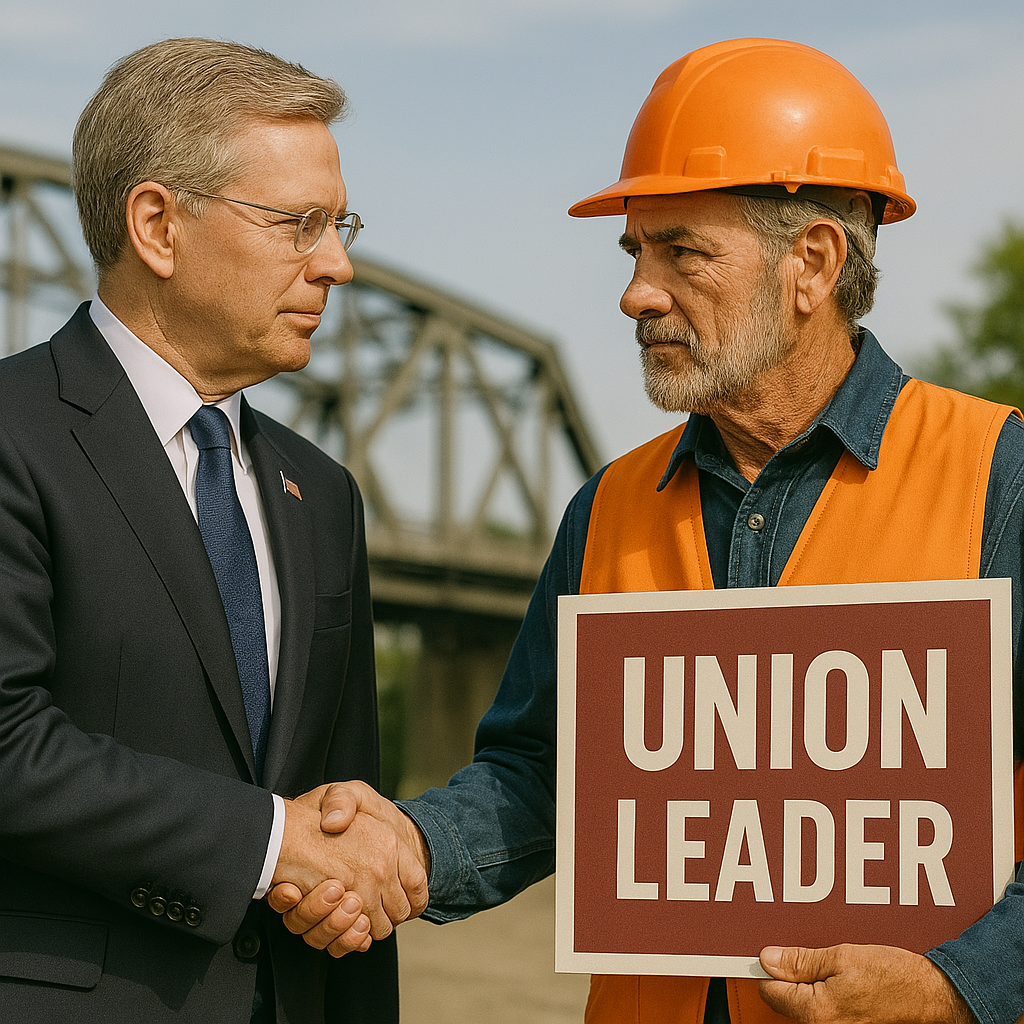
Is the Government “In Bed” with the CFMEU?
Financial Links: Donations, Contracts, and a Dance of Mutual Benefit
The relationship between the CFMEU and Australia’s Labor Party has long resembled a fraught marriage—publicly rocky, privately transactional. Between 2020 and 2024, the CFMEU donated $1.3 million to Labor campaigns, according to Australian Electoral Commission records. While federal Labor severed formal ties in July 2024, state branches continued accepting funds until late 2023.
This financial lifeline bought influence: leaked emails from Premier Jacinta Allen’s office, obtained under the FOI Act in March 2025, show advisers urging “strategic caution” on union reforms to avoid “electoral fallout.” Meanwhile, state and federal governments paid the CFMEU $3 million for “training programs” even as its leaders faced corruption probes—a paradox likened by critics to “funding arsonists to teach fire safety.”
The quid pro quo extends to procurement. A 2025 investigation revealed that 60% of contracts for Victoria’s Big Build went to CFMEU-linked firms, despite higher bids from competitors. One tender for the Suburban Rail Loop listed “union compatibility” as a criterion—a thinly veiled nod to contractors willing to pay kickbacks.
Mick Gatto’s M Group Trades, blacklisted in NSW for tax defaults, secured $14 million in Victorian state contracts. “When governments fund crooks, they become crooks by proxy,” remarked investigator Geoffrey Watson SC. For taxpayers, it’s a double betrayal: their dollars fund both infrastructure and underworld profits.
Delayed Reforms: A Timeline of Avoidance
The Albanese government knew about CFMEU corruption long before the headlines. In 2023, ASIO briefed PM Albanese on bikie infiltration risks, warning of “systemic vulnerabilities” in construction. Yet, reforms stalled. Labor’s 2022 abolition of the Australian Building and Construction Commission (ABCC)—a watchdog with prosecutorial teeth—left a vacuum filled by CFMEU strong-arming.
Internal documents from the Fair Work Commission, obtained by The Australian Financial Review, show a 40% spike in union-related disputes post-ABCC. Contractors now liken reporting corruption to “handing a grenade to a kangaroo—it’ll blow up in your face,” as one Sydney builder told 60 Minutes.
State Labor mirrored this inertia. Despite Peter Danton’s 2015 warnings about bikie infiltration, Victoria’s Andrews and Allen governments took no substantive action until the 2024 60 Minutes Australia exposé forced their hand. Even then, reforms were half-measures. The Wilson Inquiry, launched with promises of transparency, avoided questioning ministers or bureaucrats. Its final report, dubbed a “masterclass in evasion” by Watson, blamed “cultural issues” rather than individuals.
For victims like Lily Munro, such delays are a bitter pill: “They knew. They always knew. But we weren’t worth the political risk.”
Superficial Accountability: The Illusion of Action
Accountability in the CFMEU saga has been as elusive as a mirage in the Outback. Take the Wilson Inquiry: tasked with probing corruption, it produced a 200-page report that named no names, cited no whistleblowers, and ignored evidence of ministerial briefings. Former transport bureaucrats told The Age they were “advised to stay vague” during testimony. Meanwhile, Victoria Police’s Operation Hawk has secured just three convictions from 55 cases since 2023—a success rate one detective privately called “embarrassing.”
The federal response has been equally lackluster. Despite pledging to “stamp out corruption” in 2024, Labor has yet to introduce legislation targeting union-crime links. A proposed federal anti-corruption body, promised by Albanese in 2022, remains stalled in parliamentary debates. In contrast, the Coalition’s push for U.S.-style RICO laws—which would criminalize racketeering conspiracies—has gained bipartisan public support but faces union-backed resistance. “Without laws to dismantle these networks, we’re just rearranging deck chairs on the Titanic,” said former AFP Commissioner Andrew Colvin.
READ ALSO: Government Funding in Construction: A Critical Analysis of Impact vs Intent
The Way Forward: Dismantling the Machine
Australia’s response to CFMEU corruption must start with laws that bite. Peter Dutton’s proposed RICO-style legislation, modeled on U.S. anti-mafia laws, would allow prosecutors to target entire criminal enterprises—not just individuals. Under such laws, Mick Gatto’s network could be dismantled through asset seizures and conspiracy charges. NSW’s Strike Force Raptor, which crushed bikie dominance in construction through relentless raids, offers a blueprint. Expanding its mandate nationally, as suggested by the Australian Crime Commission, would disrupt the “honeypot” of state projects.
Simultaneously, a National Crime Commission focused on construction-sector corruption—akin to the 1980s Costigan Royal Commission—could subpoena ministers, union bosses, and corporate executives. “We need a spotlight so bright, the roaches scatter,” argued former judge Anthony Whealy QC. Italy’s success in eroding mafia power through such commissions proves this approach works—if political will exists.
Union Accountability: Restoring Trust from Within
The CFMEU cannot reform itself without external pressure. Federal administrator Mark Irving KC has begun this work, replacing compromised delegates and auditing EBAs. Yet, lasting change requires empowering rank-and-file members. Watson’s report urged reinstating democratic elections for delegates, currently appointed by opaque panels. Whistleblower protections, akin to the U.S. Dodd-Frank Act, would shield workers like Lily Munro from blacklisting.
Transparency is equally critical. Real-time public dashboards for union finances and contractor payments, piloted in Canada’s construction sector, could demystify deals. “Sunlight is the best disinfectant,” said Transparency International’s Serena Lillywhite. For the CFMEU, this means publishing all labour hire agreements and expelling members with criminal ties—a policy enforced by Germany’s IG Bau union since 2018.
Government Action: From Complicity to Courage
Governments must end their Faustian bargain with the CFMEU. Reinstating the ABCC with enhanced powers to audit projects and ban corrupt firms is step one. The UK’s Procurement Act, which bars companies linked to organized crime from public tenders, offers a model. At the state level, Victoria’s IBAC has recommended “integrity tests” for contractors—random audits to detect ghost shifts and kickbacks.
Political courage is the final ingredient. Premier Jacinta Allen must reopen the Wilson Inquiry, this time with powers to compel testimony from ministers. Federally, Labor must fast-track its dormant anti-corruption body and adopt RICO laws. As The Sydney Morning Herald editorialized, “History will judge this era not by the scandals, but by the reforms they inspired.”
Conclusion: A Rotting Foundation – Australia’s Crossroads of Integrity
The CFMEU’s descent into criminality did not erupt overnight. It is the culmination of decades of strategic neglect—a slow-burning fuse lit by union leaders who turned a blind eye, governments that prioritized political convenience over accountability, and a regulatory system gutted of its teeth. As far back as 2002, a Royal Commission labeled Mick Gatto a “standover man” for construction firms, yet successive governments treated the CFMEU’s underworld ties as a nuisance rather than a national crisis.
Like termites in a timber frame, the rot spread unchecked. By the time 60 Minutes Australia exposed the metastasis in 2024, the union’s Victorian branch had become a crime syndicate masquerading as a labor advocate, its tentacles strangling the very projects meant to uplift communities.
Australia now stands at a crossroads. The CFMEU saga is more than a union scandal—it is a referendum on the nation’s tolerance for institutional decay. Taxpayer dollars funding bikie payouts, women brutalized with impunity, and ministers dodging scrutiny are not mere headlines; they are symptoms of a democracy corroding from within.
The path forward demands more than piecemeal reforms. It requires dismantling the machinery of corruption through RICO laws, reviving fearless oversight bodies, and purging political agendas from procurement. History offers a stark lesson: societies that tolerate festering corruption inevitably crumble under its weight. For Australia, the choice is clear—build a future anchored in transparency, or let the CFMEU’s rot become the nation’s epitaph.
Final Note
The CFMEU crisis mirrors global struggles against organized crime—from Italy’s mafia to America’s Teamsters. The difference lies in response. Italy’s Direzione Investigativa Antimafia (DIA) and the U.S. RICO Act show that systemic corruption can be dismantled with laws, courage, and public resolve. Australia must now decide: Will it learn from these examples, or will the CFMEU’s shadow endure as a monument to failure?