October 2026 editorial series. First published online 16 November 2026.
A program slips, but the completion date does not. The next trade inherits the delay. The supervisor is told to recover the time, the crew is told to work smarter, and somebody puts a wellbeing poster in the lunchroom.
This is an illustrative situation, not an account of a particular project. It exposes a question construction businesses need to answer: are we helping people cope with pressure, or changing the decisions that keep producing it?
Both forms of support have a place. A worker who is struggling deserves care, privacy and access to appropriate help. But psychosocial risk in construction cannot be managed only after someone shows signs of strain. It also needs attention in the program, the handover, the staffing decision and the way authority is distributed.
The practical shift is from asking whether workers are resilient enough to asking whether the work is reasonably designed, properly supported and open to correction. That is a leadership responsibility, and it does not disappear when the commercial pressure is real.
Psychosocial risk in construction is already on the inspection agenda
On 21 August 2025, SafeWork NSW announced a targeted construction compliance operation on the Central Coast. Alongside falls, machinery and hazardous substances, the announced priorities included high work demands, low support and harmful behaviour. The release also identified poor planning and inadequate supervision among problems seen during the preceding statewide operation. These were not presented as matters to leave until the project had more time.
For a construction leader, the relevance is straightforward. Psychosocial risk is not a separate conversation that only belongs with human resources. The decisions that organise production also influence how people experience the work. A supervisor can be respectful and still be operating inside a plan that leaves people with conflicting instructions, insufficient resources and no workable route to resolve a problem.
SafeWork NSW’s Mental Health in Construction findings report covers visits to 426 sites between November 2024 and March 2025. It reported that 22% had no adequate controls under the relevant psychosocial-control question, while 84% relied on informal discussions to communicate about psychosocial hazards and their management. These are findings from the visited sites, not an estimate of every Australian construction business.
The lesson is not that an informal conversation is worthless. On a small project it can be essential. The question is whether the conversation changes anything, whether everyone affected can participate, and whether a recurring problem has an owner with the authority to act.
Separate the hazard from the person experiencing it
A psychosocial hazard is something about work that can cause psychological harm. Risk concerns the possibility and seriousness of harm arising from exposure. A worker’s distress may signal a problem, but it is not itself an adequate description of the working condition that needs attention.
Safe Work Australia identifies job demands, low job control, poor support, unclear roles and harmful interactions among psychosocial hazards. It also explains that hazards can interact. A heavy workload is a different experience when someone has competent help and room to make decisions than when they are isolated, uncertain and unable to obtain an answer.
This distinction matters when discussing psychosocial risk in construction. “The foreman is stressed” may lead to a check-in. “The foreman receives incompatible instructions from two managers and cannot authorise a change” points towards a decision the business can examine. The check-in still matters, but it should not be the end of the response.
This article offers leadership guidance, not legal advice or a complete assessment method. Requirements and approved codes differ across jurisdictions. Use the relevant regulator’s guidance and competent advice for the work involved. Do not assume a training course, survey or checklist establishes compliance.
Follow a difficult shift backwards
Start with a recurring situation rather than a general claim that morale is poor. Ask the people doing the work to describe where the day becomes difficult. Then examine the decisions before that moment. The aim is to understand the sequence, not find a convenient person to blame.
Consider a hypothetical work front where late drawing changes repeatedly produce rework. The immediate response might be to tell the crew to pay more attention. Following the sequence backwards could reveal that the updated drawing reached one subcontractor but not another, that nobody owned the cross-trade briefing, and that the supervisor was expected to absorb the lost time without revising the plan.
That account changes the response. Clearer communication is useful, but the business also needs a reliable revision process, a named coordinator and a decision about the downstream timetable. Otherwise the supervisor is being asked to communicate an unworkable arrangement more politely.
- Repeated problem: late rework creates a rushed afternoon.
- Earlier decisions: changed information was not coordinated across trades.
- Exposure: conflicting instructions, high demands and little control.
- Work change: one revision owner, a joint handover and a reviewed sequence.
- Check: ask affected crews whether the same conflict returns.
Illustrative leadership analysis, not a formal risk-assessment template.
Five work-design questions leaders should be able to answer
Is the workload achievable with the resources actually available?
A plan can be achievable on paper because it assumes perfect attendance, uninterrupted access and every delivery arriving as promised. The practical question is what happens when those assumptions fail. Who can revise the sequence, add support or negotiate the consequence upstream?
Listen for workarounds that have become routine: missed breaks, unfinished handovers, people staying late to conceal a planning gap, or an experienced worker constantly rescuing a task. These observations need examination in context, not automatic diagnosis. They can nevertheless reveal where the planned work and the available capacity have drifted apart.
Do responsibility and authority match?
Being accountable for a result without being able to influence the conditions creates a difficult leadership position. A supervisor needs to know which decisions they can make, which require approval and who will respond when the usual contact is unavailable.
This is not an argument for bypassing technical controls or allowing an unqualified person to redesign safety-critical work. It is an argument for making decision routes usable. “Escalate it” is not a complete answer if nobody owns the escalation or knows when a response is needed.
Can people identify the current instruction?
When the plan changes, workers need more than another message in a busy group chat. They need to know which instruction supersedes the previous one, who is affected and how to resolve conflicting directions. Acknowledging receipt is not necessarily the same as understanding the effect on the task.
EPIC’s guide to setting clear expectations as a construction supervisor examines the human side of this. Work design supplies the supporting system: a reliable source of current information and enough time to explain it before the affected work proceeds.
Is support available where the work happens?
A nominated contact is not much help if they are unreachable on a night shift or covering several work fronts at once. Ask workers what happens when they are unsure. Check whether advice is competent, timely and accessible, and whether the backup arrangement is understood.
Support also includes the resources to do the job. Reassurance cannot replace suitable equipment, an appropriate staffing decision or a clear training arrangement. Managing psychosocial risk means examining these practical conditions alongside how people speak to each other.
What behaviour does the business reward?
If a manager praises delivery without examining the cost imposed on the crew, people learn what matters. If raising a problem earns embarrassment while concealing it avoids attention, they learn something else. The written commitment to respect is tested when the program is under pressure.
That is why EPIC connects leading under pressure with the wider organisation. Supervisors should be supported to address problems early, not expected to protect the appearance of control until the situation becomes harder to resolve.
Choose a control, not another reminder
“We reminded everyone” describes an activity. It does not explain what changed about exposure. Sometimes people need better information; sometimes the underlying arrangement needs redesign. The response should match the problem rather than defaulting to the easiest intervention to count.
| Observed problem | Weak response on its own | Work change to consider | Evidence to check |
|---|---|---|---|
| Two managers issue incompatible directions. | Tell the supervisor to communicate better. | Agree one coordination owner and a route for resolving conflicts. | Can the crew identify the current instruction? |
| A late trade compresses every later task. | Ask everyone to be more resilient. | Review downstream sequencing, resources and commitments. | Has the recurring rush reduced without moving it elsewhere? |
| Workers cannot obtain advice on a remote shift. | Repeat the office contact number. | Provide a competent, available backup arrangement. | Do workers obtain useful answers when needed? |
| People fear consequences for reporting. | Display another reporting poster. | Provide a credible alternative route and address retaliation risk. | Do people understand and trust the response process? |
These examples are not prescribed controls for every site. Assess the actual circumstances, involve relevant expertise and consider whether a change creates a new risk. Reducing one team’s workload by transferring it silently to another is not a satisfactory result.
The work crosses business boundaries, so the conversation must too
A principal contractor may control the program while a subcontractor controls staffing and another business controls access. Asking one supervisor to resolve psychosocial risk without those decision-makers can produce a list of frustrations rather than an effective response.
Bring the right people together around a specific problem. Establish who controls each part of the arrangement, what can change immediately and what needs a decision elsewhere. Workers should have a meaningful opportunity to explain how the arrangement operates, including those on different shifts or short-term assignments.
A well-run toolbox discussion can uncover important information, but it will not replace every consultation arrangement. Sensitive concerns may need a confidential channel, and a worker should not have to describe a personal experience of harassment in front of the crew to make the issue visible.
There is also a useful Australian development to understand. On 8 April 2026, Safe Work Australia released construction-specific resources on gender-based violence. Its explanation connects harmful behaviour with conditions such as high demands, low support and isolated work. The accompanying case studies are instructional illustrations, not reports of identified employers. The relevance is that behaviour and work design need to be considered together, rather than assigned to separate silos.
Give every agreed action an owner and a review
An action needs a responsible person with authority, a timeframe and a way to check whether it helped. “Improve communication” leaves all three unclear. “The coordinator will confirm the current revision with both affected crews before the changed task begins” is a more usable commitment.
Review implementation first. Was the action actually taken? Then review its effect. Did conflicting instructions reduce? Can workers obtain a decision sooner? Did the workaround disappear, or simply become less visible? An action can be completed without solving the problem it was intended to address.
Do not use a low number of complaints as proof that psychosocial risk is controlled. Silence can have several explanations. Combine work observations, appropriate records and worker feedback, and protect personal information throughout. The point is to understand the work, not create a surveillance exercise.
For a first improvement cycle, choose one recurring problem, establish the current arrangement, consult affected people and trial an appropriate change. Set a review date that fits the exposure and urgency. Immediate danger, serious allegations or acute distress require the appropriate immediate response, not a place on next month’s improvement agenda.
Practical questions about psychosocial risk in construction
Does this mean every difficult day is unsafe?
No. Demanding work and ordinary disagreement are not automatically evidence of injury or unlawful conduct. Examine the conditions, the exposure and the available controls. The useful question is whether the business is identifying and responding to preventable risk, rather than dismissing it because pressure is familiar.
Can leadership training solve the problem?
Training can strengthen recognition, communication and response. It cannot authorise a supervisor to change a budget they do not control or fix a staffing decision made elsewhere. Capability development and organisational action need to support each other.
Where should a small contractor start?
Start with the work that repeatedly produces confusion, unreasonable pressure or a lack of support. Ask the affected workers what happens, identify who can change the arrangement and use relevant regulator guidance. A small business needs a proportionate process, not permission to ignore the issue.
Build the capability to change the working day
Psychosocial risk in construction becomes easier to discuss when leaders can connect it to decisions people recognise: the rushed handover, the unsupported shift, the unclear instruction and the problem that travels from one trade to the next.
EPIC RISE supports learning about psychosocial safety and workplace behaviour. EPIC Elevate develops the practical people skills supervisors need to lead these conversations. Neither removes the employer’s responsibility to act on the conditions identified.
The standard worth pursuing is not a site where nobody ever feels pressure. It is a workplace where pressure can be discussed honestly, avoidable problems are addressed at their source, and the people responsible for delivery have the support to do it without passing harm down the line.
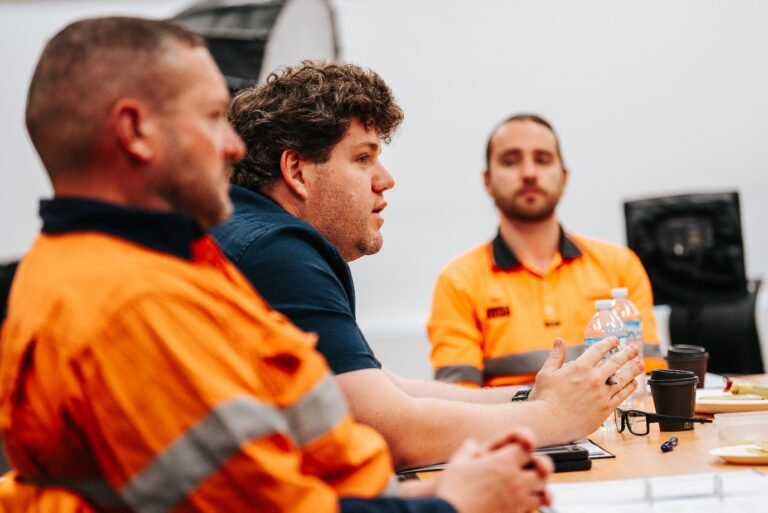
Featured image: Troy Mortier / Unsplash. Illustrative construction image, not documentation of the inspections or examples discussed.